Deep Sets
A PyTorch implementation of permutation invariant and equivariant neural networks on sets.
Deep Sets (Zaheer et al., NeurIPS 2017) is a universal architecture for learning functions on sets — collections of elements where order does not matter. This library provides a complete, tested implementation of every architectural variant described in the paper, with support for variable-size sets, multiple pooling strategies, and context conditioning.
@inproceedings{zaheer2017deep,
  title     = {Deep Sets},
  author    = {Zaheer, Manzil and Kottur, Satwik and Ravanbakhsh, Siamak and
               Poczos, Barnabas and Salakhutdinov, Russ R and Smola, Alexander J},
  booktitle = {Advances in Neural Information Processing Systems},
  pages     = {3391--3401},
  year      = {2017}
}
Architecture Overview
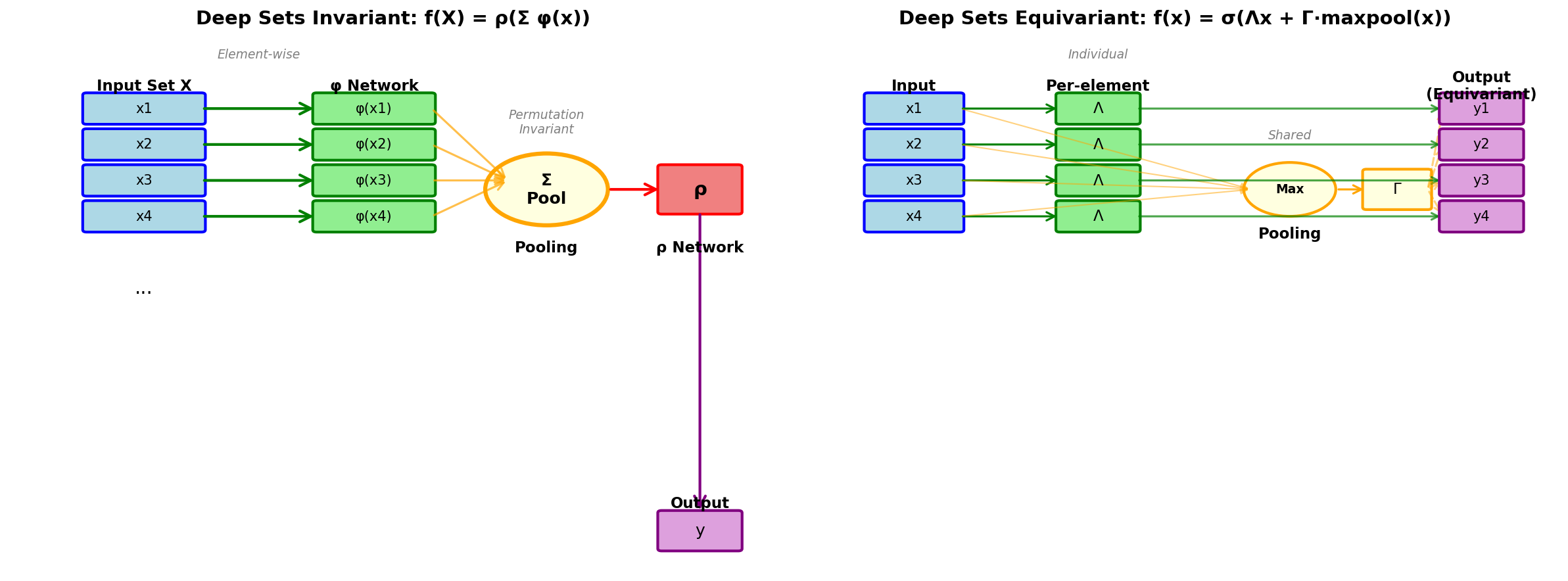
The core idea: any permutation invariant function \(f\) can be written as
\[f(\mathcal{X}) = \rho\!\left(\sum_{x \in \mathcal{X}} \varphi(x)\right)\]
where \(\varphi\) transforms each element independently and \(\rho\) processes the pooled result.
Key Features
| Feature | Description |
|---|---|
| Invariant models | DeepSetsInvariant — set → value mappings (classification, regression) |
| Equivariant models | DeepSetsEquivariant + PermutationEquivariantLayer — set → set mappings |
| Conditional models | DeepSetsConditional — context-conditioned set processing |
| Variable-size sets | First-class masking support across all model types |
| Pooling options | Sum, max, and mean pooling with correct mask handling |
| Theoretical basis | Implements Theorem 2 (invariance) and Lemma 3 (equivariance) exactly |
Quick Links
- Tutorials — Learning-oriented
- New to Deep Sets? Start here for guided, hands-on introductions. Getting Started · Training a Model
- How-to Guides — Task-oriented
- Practical recipes for specific tasks. Variable-Size Sets · Pooling Strategies · Equivariant Models · Conditional Models
- Reference — Information-oriented
- Complete API documentation for every class and function. API Reference
- Explanation — Understanding-oriented
- Theory, proofs, and design rationale. Deep Sets Theory · Architecture Decisions